MY DEVELOPMENT
Turning one doorway into a shared learning direction.
SERVICE DESIGN · DISCOVERY · REQUIREMENTS ENGINEERING
I led the early discovery and requirements framing for a learning experience platform, bringing together perspectives from across the organisation.
Later, I returned to evaluate candidate platforms against the experience requirements. The wider programme went on to launch MyDevelopment.
MY CONTRIBUTION: EARLY DISCOVERY AND REQUIREMENTS · LATER UX EVALUATION

From the original “one doorway into learning” ambition to MyDevelopment, the platform subsequently launched by the wider programme.
THE BRIEF WAS A WARDROBE.
The project began as Narnia: one doorway into a world of learning.
It was an evocative ambition, but it left important questions open. What were people trying to learn? Where did the existing experience get in their way? What should a shared platform make possible?
I reframed the starting point around how learning worked today, what needed to improve and what an exceptional experience would enable.
That gave discovery a purpose before we began comparing platforms.
GETTING THE ORGANISATION INTO THE ROOM.
Learning crossed business areas with different needs, systems and ways of working.
I brought together perspectives from Investments, Retirement, Digital, Insurance and Group People and HR teams. The workshops explored current frustrations, learning motivations and the future people wanted to work towards.
The Sailboat exercise surfaced fragmented systems, organisational silos, awkward technology and limitations in data and reporting.
Making those issues visible helped establish a shared starting point for the requirements.
Caption beneath the image:
Cross-divisional discovery explored what helped learning, what held it back and what a better experience needed to enable.

Cross-divisional discovery explored what helped learning, what held it back and what a better experience needed to enable.

TURNING INPUT INTO DIRECTION.
Across five meetings and workshops, discovery generated around 1,400 contributions. The useful work was turning that material into a direction the programme could use.
I synthesised the input into a shared vision and seven prioritised learning journeys, spanning onboarding, mandatory training, personalised learning, career development, core knowledge and technical skills, manager support, and company culture and strategy.
Those journeys gave the requirements a practical reference point: the situations and needs the future experience had to support.
Left image: Discovery was consolidated into a shared vision, seven priority journeys, and functional and behavioural requirements.
MAKING THE AMBITION SPECIFIC ENOUGH TO PROCURE.

The discovery outputs connected the learning vision to roles, journeys and priorities, then translated those into functional and behavioural requirements.
Functional requirements described the capabilities needed. Behavioural requirements addressed how the experience should support people in using them. Together, they informed the feature requirements for the request for proposal.
This gave the programme a basis for comparing platforms against the learning experience it wanted to create.
RETURNING TO EVALUATE THE EXPERIENCE.
My involvement resumed later, when I was brought back to review candidate platforms from a user-experience perspective.
I assessed the options against real learning journeys and practical considerations, including personalisation, content management, engagement, analytics and support. The evaluation connected the earlier requirements to the experience each platform could offer.
The wider programme subsequently launched MyDevelopment. The launch material returned to the original ambition with a more concrete expression: a single front door for learning.
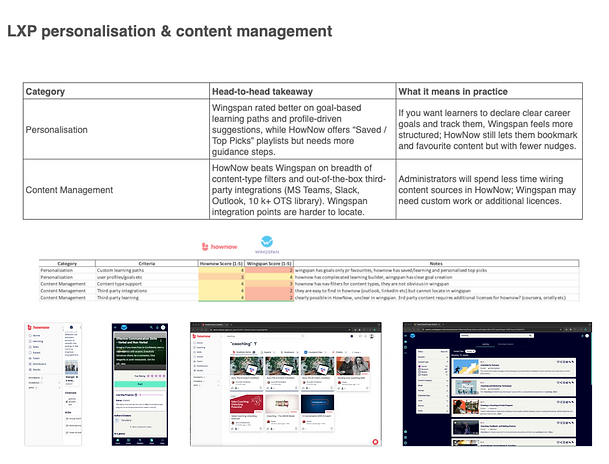
My later UX evaluation examined candidate platforms against the learning journeys and experience requirements.

The wider programme’s launch announcement: the original ambition carried forward into MyDevelopment.
FROM DISCOVERY TO A SHARED DIRECTION
5
Discovery meetings and workshops.
7
Prioritised learning journeys.
2
Requirement types: functional and behavioural.
LAUNCHED
MyDevelopment delivered by the wider programme.
My contribution covered early discovery and requirements framing, followed by a later UX evaluation. Implementation and launch were delivered by the wider programme team.
WHAT I'D CARRY FORWARD
compelling metaphor can bring people together while leaving them with different pictures of what success means.
Discovery made those differences discussable. It gave the programme a shared view of the journeys and capabilities that mattered, and requirements specific enough to inform procurement.
Returning for the platform evaluation reinforced the value of that early work. We had something concrete to test the options against.
I’d carry that discipline into the next project: define the experience people need, then use it to guide the technology decision.